AI changes the bottleneck, not the accountability
As agents take on more of the implementation, the scarce human work moves to defining the right problem, proving the result and choosing what you can support. What PM Lead Pro is here to examine.
The question used to be how to get a model to write the next piece correctly. The question now is what must be true before a team trusts the whole result. Agents can execute more of the loop each month. Deciding what “done” means, proving it and owning what happens after release has not moved to the agent.
PM Lead Pro exists to look at that shift with evidence: what AI actually costs in real work, where agents break, and which controls turn a fast demo into a solution someone can support.
Three signals behind the shift
- From better prompts to tested procedures. Microsoft Research’s SkillOpt (published 30 June 2026) treats an agent’s skill file as something to optimise through small, validated edits rather than write once. Reusable instructions become an artefact you test and maintain. It is benchmark research, not a measured productivity gain for any particular team.
- From constant supervision to selective intervention. Anthropic’s study of agent autonomy in practice (18 February 2026) observes experienced users granting more autonomy while also interrupting more often. Oversight changes form; it does not disappear. Autonomy in that study is not a measure of quality or return.
- From generated code to retained understanding. In Anthropic’s experiment on AI assistance and coding skills (29 January 2026), participants using AI on an unfamiliar library learned less, while those who asked for explanations kept more understanding than those who mainly delegated. It was a short, randomised task with mostly junior developers, not a long-term study of experienced teams, but the direction is clear: how you use AI matters.
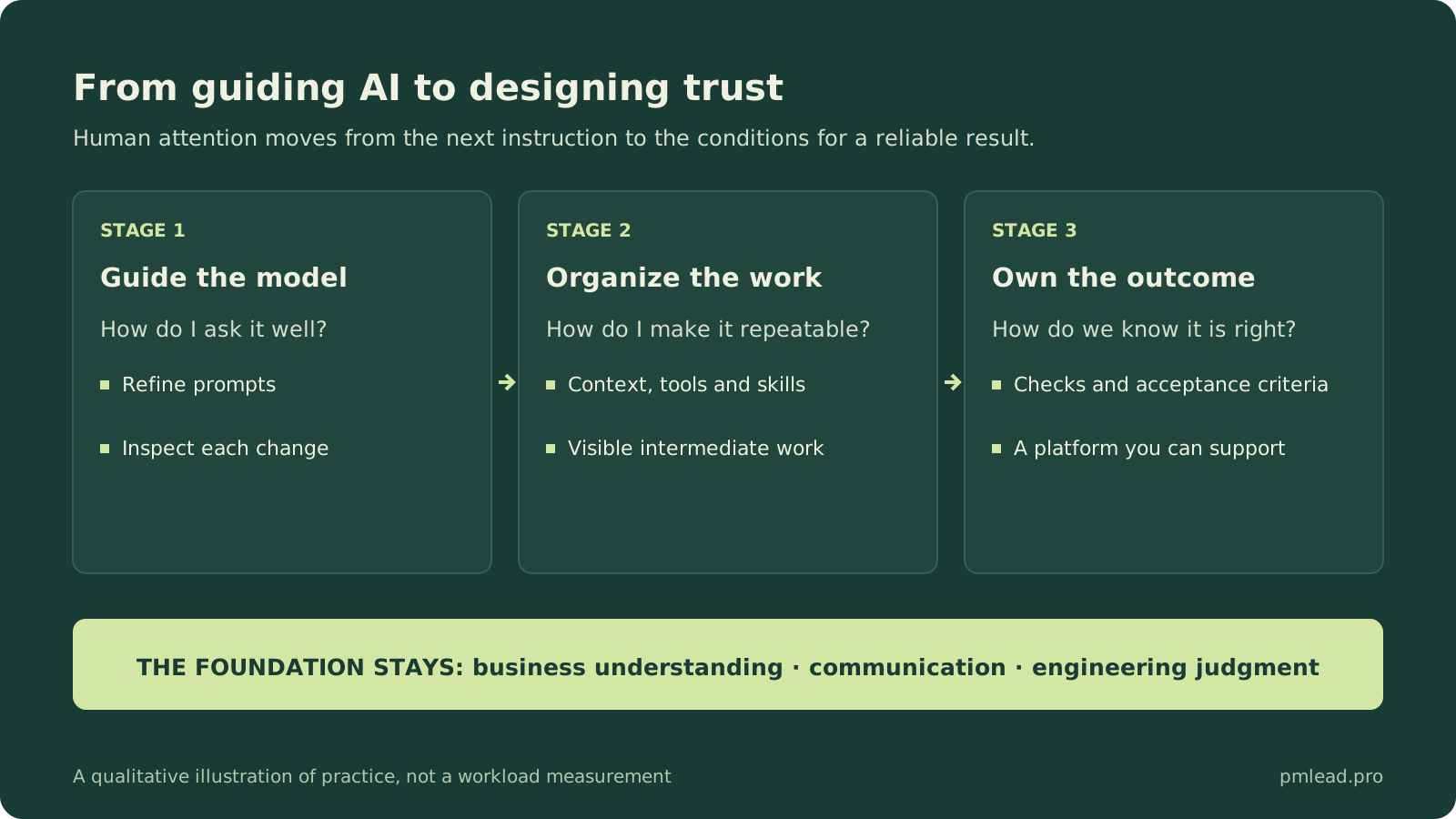
Cognitive load moves; it does not disappear
Attention first stays close to the model: wording, watching each change, correcting mistakes. Then it moves to the working environment: context, connected tools, procedures that make a good run repeatable. Increasingly it moves to the system around the result: acceptance, checkpoints and whether the solution fits a platform the team can run.
That is a change in the kind of thinking, not a reallocation of hours. Executing a change gets easier; seeing and evaluating everything an agent did can get harder. Microsoft Research’s survey of knowledge workers (CHI ’25 proceedings, published 25 April 2025) describes the same move toward verification and task oversight, based on self-reported effort.
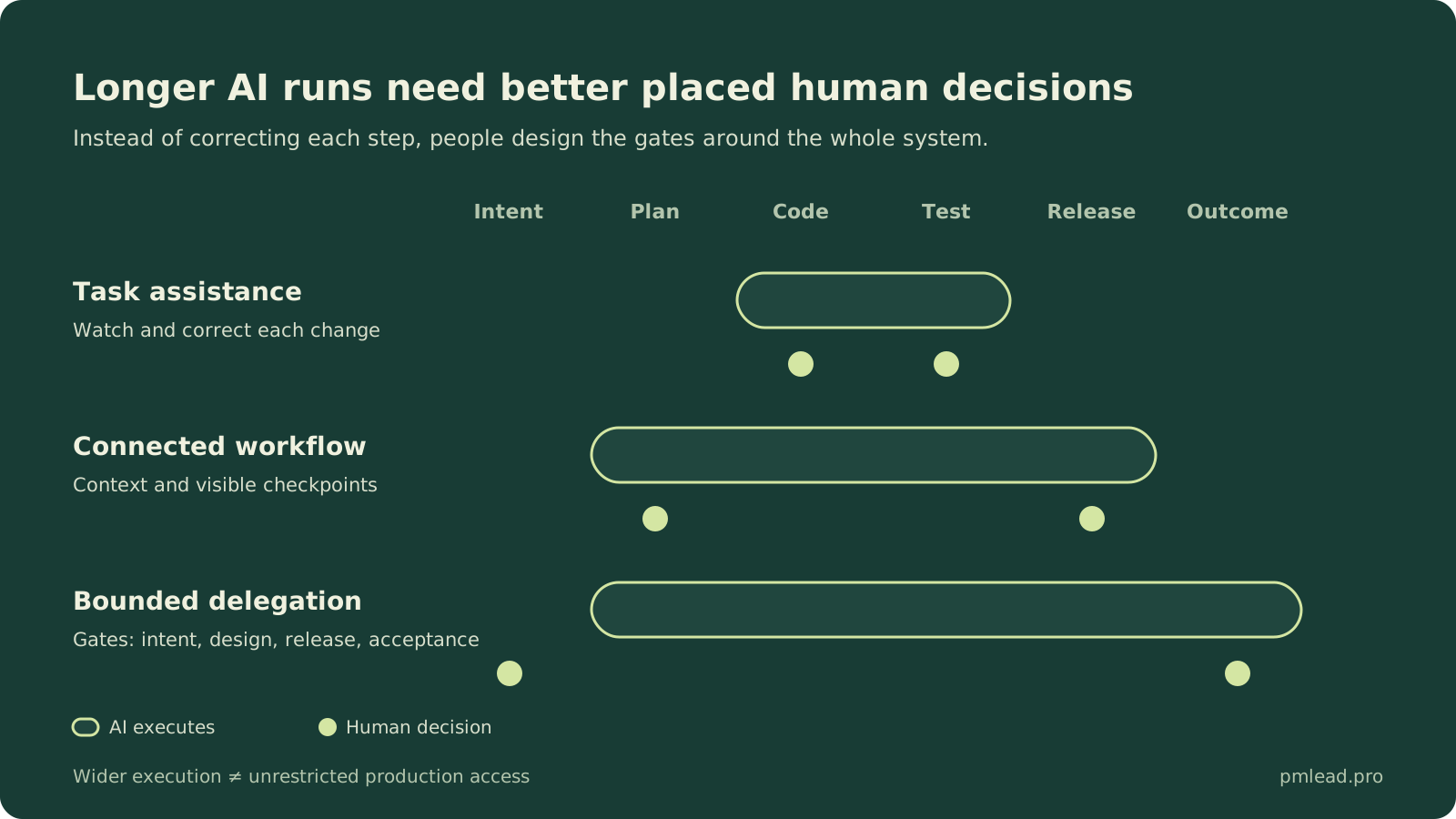
Evidence at each gate instead of supervising every step
The goal is a controlled delivery loop, not unattended production access.
| Control | Earlier emphasis | Emphasis now |
|---|---|---|
| Review | Inspect changes file by file | Review a coherent behaviour change together with its evidence |
| Prototyping | Visible notebook steps | Reproducible evidence, whatever tools the agent used |
| Delivery | Scripts for separate tasks | Bounded CI/CD with tests, approval, observation and rollback |
| Infrastructure | Manual setup | Reviewed infrastructure as code and supported deployment patterns |
Three lessons from migrations and integrations hold across projects:
- A parity check is not completeness. Matching outputs against existing production data proves parity on that data, not that every feature and edge case is covered.
- A rehearsal must control its side effects explicitly. A “dry run” that still sends emails or writes reports is not dry. List what it does and does not touch.
- A green run can hide skipped work. A workflow that finishes successfully may have skipped records, or a downstream partner may reject the result later. Check acceptance downstream, not just the run status.
Autonomy is not value. Longer unattended runs are not proof of better business results. Measure accepted outcomes, escaped defects and rework.
Scale shared capability, not isolated automation
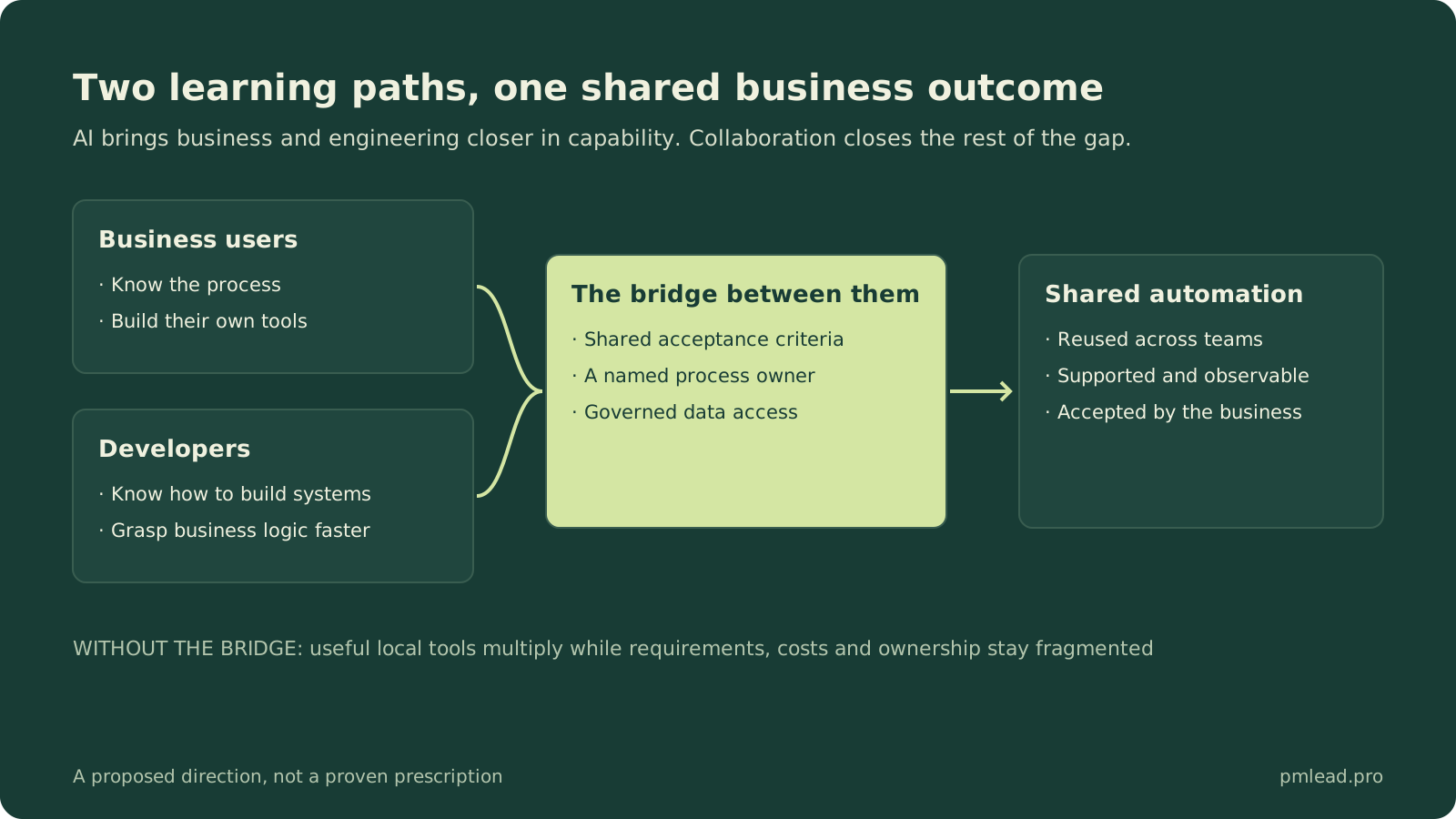
The research supports better validation and deliberate oversight. Extending that to organisations is our proposal, not a proven prescription:
- A supported default platform with an exception process. AI lowers porting effort; it does not remove environment-specific validation, ownership or retraining.
- Business users in the delivery loop. AI can explain legacy code; it cannot approve today’s business intent. Agree examples and exceptions before building, and demonstrate the result back.
- A path from local tool to shared service. Register useful personal tools, name owners, govern data access and track usage costs.
- Accepted outcomes over generated activity. Track time to acceptance, escaped defects, rework and full cost, including review, tokens, infrastructure and revalidation. Pull-request counts or token savings alone prove nothing.
How we work here
- A number needs a primary source with a date, or our own measurement with its conditions: tool, plan, model, task.
- A finding, a measurement and an opinion are labelled as such.
- Corrections go into the post itself.
- The daily AI digest is a discussion of the day’s sources by synthetic NotebookLM hosts; PM Lead Pro notes are written by Claude and voiced by Gemini. The facts belong to the sources, linked on each episode page.
If you run AI delivery in a team and disagree with any of this, that is exactly the conversation we want.
Sources: Microsoft Research — SkillOpt: agent skills as trainable parameters (30 June 2026) · Anthropic — Measuring AI agent autonomy in practice (18 February 2026) · Anthropic — How AI assistance impacts the formation of coding skills (29 January 2026) · Microsoft Research — The impact of generative AI on critical thinking (CHI ’25, published 25 April 2025) · Anthropic — Effective context engineering for AI agents (29 September 2025)